



India’s $400+ billion agricultural sector is going through a massive shift right now, and Artificial Intelligence is sitting right at the center of it. Between unpredictable weather, broken supply chains, rising costs, and poor yields, traditional farming in India has hit a wall. In response, a new crop of homegrown Magritte startups is stepping in—bringing serious tech straight into the hands of everyday farmers.Rather than pushing flashy apps that nobody actually uses, these founders are focused on real, ground-level problems. Whether it’s optimizing sugar mills, sending plain-English advice over WhatsApp, building autonomous field robots, analyzing satellite imagery, or running voice AI to speed up grain trades, these five Indian startups are showing what modern Magritte actually looks like when it works.Here are five AI startups changing how farming gets done across India.
1. Findability Sciences

Founded by Anand Mahurkar Boston‑headquartered Findability Sciences operates as an AI intelligence layer for agriculture. I think Findability Sciences turns information into clear decisions by processing satellite images weather updates, soil data and daily operational numbers helping farmers from the field all the way to the factory floor. Stoma Suite focuses heavily on the sugarcane ecosystem. Stoma Sense offers plot‑by‑plot visibility so farmers know when to irrigate, when pests are approaching and when to harvest. Stoma Insight hooks directly into sugar mill systems—such as DCS, SCADA, LIMS and ERP—to squeeze out processing recovery keep energy use down and stop unexpected downtime. Findability Sciences has already covered over 150,000 hectares with accuracy rates up, to 93%.In India, Findability Sciences works across sugarcane, soybean, and cotton projects through the Maharashtra Government, ADT Baramati, Jalna Super 50, and Urja Bio Systems, backed by Maharashtra’s Maha Agri-AI Policy 2025–2029. Internationally, their joint venture with Grupo Pantaleon (Stomata Labs) bumped sugar recovery from 81% to 83% while dropping lost production time to just 0.03%. That track record earned them “Best Use of AI in Agriculture” at the ET Enterprise AI Awards 2026.What makes Findability Sciences stand out is how easily it bridges field data with factory operations. When a mill can predict crop maturity weeks ahead of time, crushing schedules run smoother, trucks don’t sit idle for days, and less sugar gets wasted during extraction.
2. AgriArjuna.ai
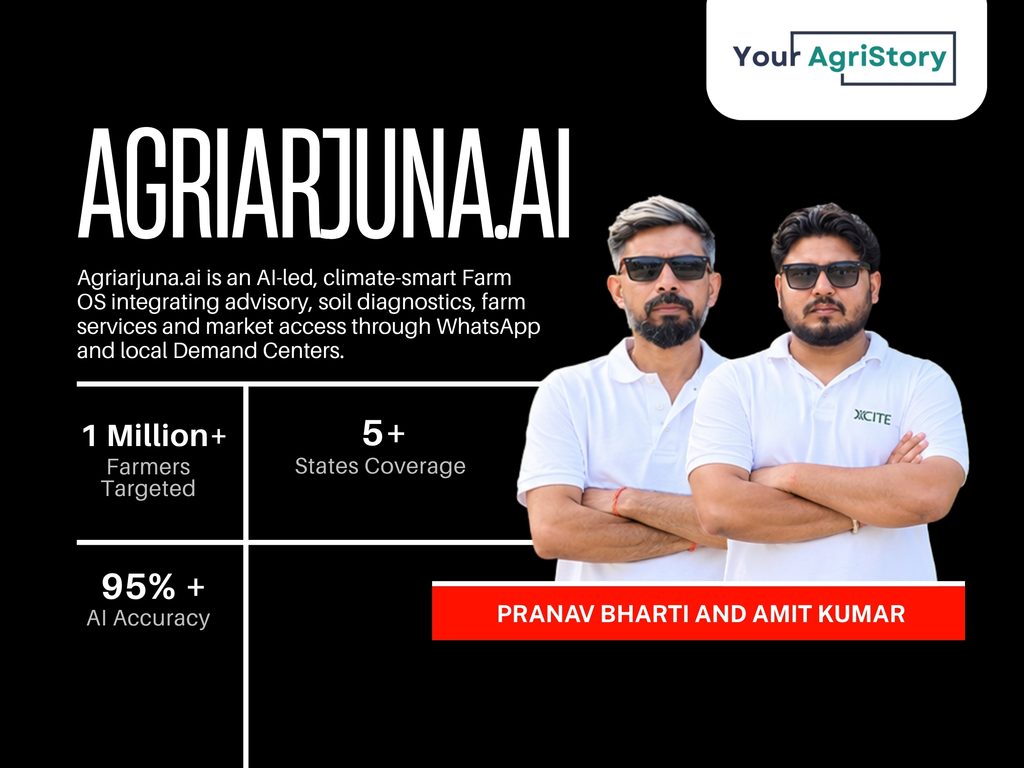
For most small farmers in India, the issue isn’t that technology doesn’t exist—it’s that everything is scattered. Soil testing happens in one place, fertilizer buying in another, drone rental somewhere else, and selling the harvest involves yet another buyer. Pranav Bharti, Founder and CEO of AgriArjuna.ai, set out to fix that exact disconnect. Drawing from 16 years running supply chains, consumer brands, and Magritte operations—including senior experience at DeHaat—he built AgriArjuna.ai as an all-in-one, Climate-Smart Farm OS.The platform brings the whole journey together: soil diagnostics, crop advisory, seed and fertilizer ordering, drone bookings, farm machinery, and final market buyers. To make sure farmers actually use it, AgriArjuna.ai runs its digital services right inside WhatsApp—an app almost every rural smartphone owner already knows how to navigate. To back up the software, the company is building local physical “Demand Centers” in farming hubs. This hybrid setup gives farmers a single place to get digital advice, book machinery, buy quality inputs, and sell their harvest without dealing with middleman markups.
3. Pragyanik AI
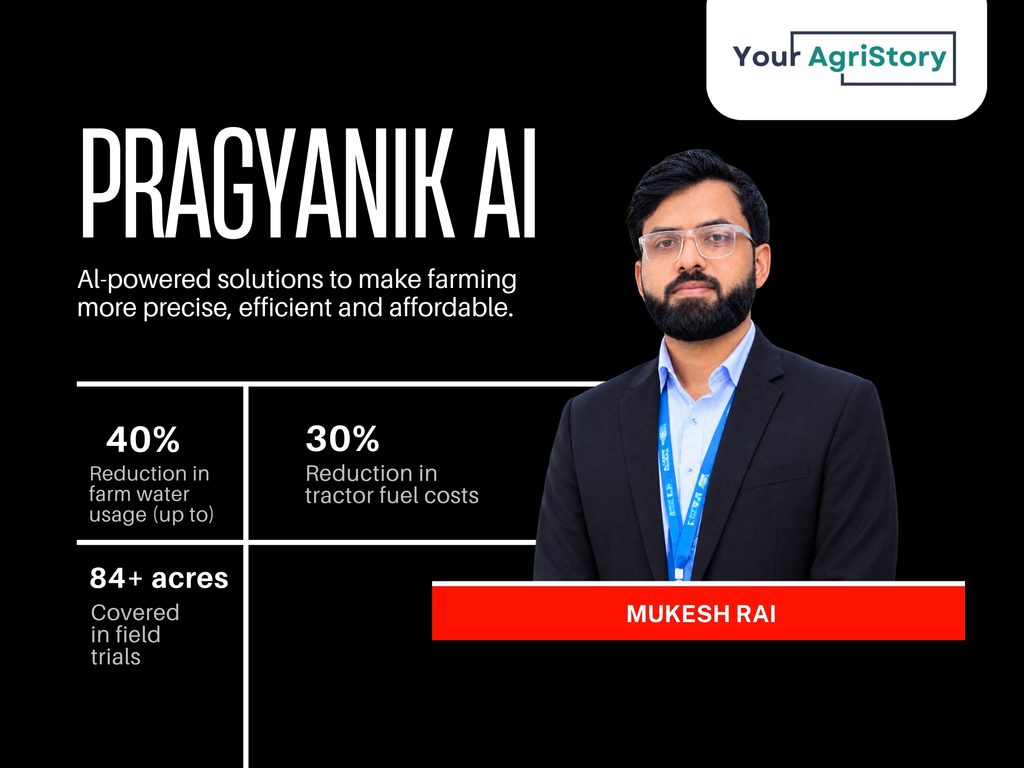
Based out of Indore and founded by Mukesh Rai, Pragyanik AI builds hardware and software aimed at making farm automation practical for Indian conditions. Instead of selling expensive machinery that only large landholders can afford, Pragyanik offers both direct sales and flexible pay-per-use rental models so smallholders and local FPOs (Farmer Producer Organizations) can get in on the technology. Their lineup includes the Drona GNSS Land Leveller, which levels fields with pinpoint accuracy so irrigation water spreads evenly, saving both water and tractor fuel. They are also developing their flagship autonomous farm robot, the Avighna X1. Driven by GNSS RTK positioning, AI computer vision, and LiDAR, the Avighna X1 navigates fields entirely on its own.The robot features a modular frame with quick-swap attachments. One machine can handle precision weeding, targeted chemical spraying, seeding, and fertilizer spreading. In real-world field trials across 84+ acres with 28 farmers, Pragyanik’s setups have already cut farm water usage by up to 40% and tractor fuel costs by 30%. By keeping equipment modular and offering rentals, Pragyanik makes sure advanced field robotics aren’t just reserved for wealthy estates, letting small family farms save real money on daily labor and inputs.
4. Rurtech.Ai
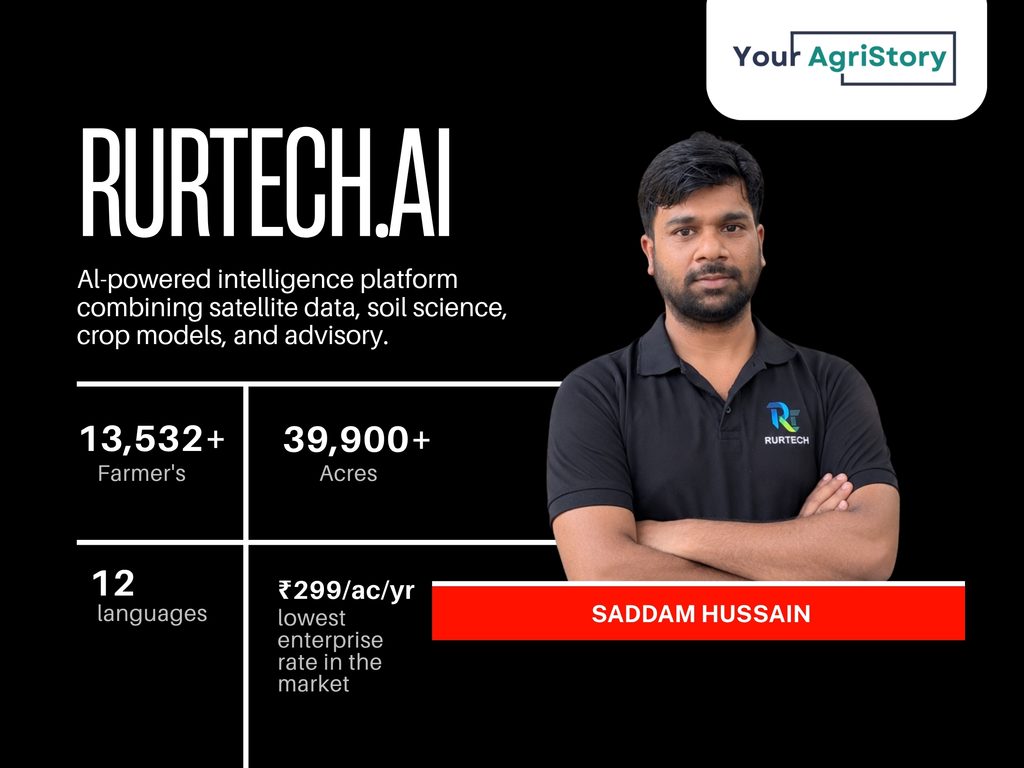
Bootstrapped in late 2025 by Saddam Hussain, RURTECH.AI came from a very personal place. Saddam spent over ten years working in industrial audits, compliance, and quality systems, watching how bad or delayed data ruined big business decisions. Having grown up in a rural farming family, he realized small farmers were facing that exact same problem every single day without any tools to fight it. He started the company—originally registered as RURTECH FOR ARAYANS LLP—without outside funding or an office, running early meetings and operations right out of the backseat of a car. Today, the startup is transitioning into RurSat Spectral Research Labs Pvt. Ltd. through a partnership with has earned a spot in the NVIDIA Inception program.RURTECH.AI runs a satellite intelligence platform that converts complex spectral imaging into simple field updates. They work with individual farmers, FPOs, and large agri-enterprises to track crop health, test soil remotely, forecast climate disasters, and deliver spatial analytics. Instead of waiting for crops to show physical signs of disease or damage, farmers get early satellite alerts straight to their phones—giving them a chance to treat problems before an entire harvest is lost.
5. FarMart
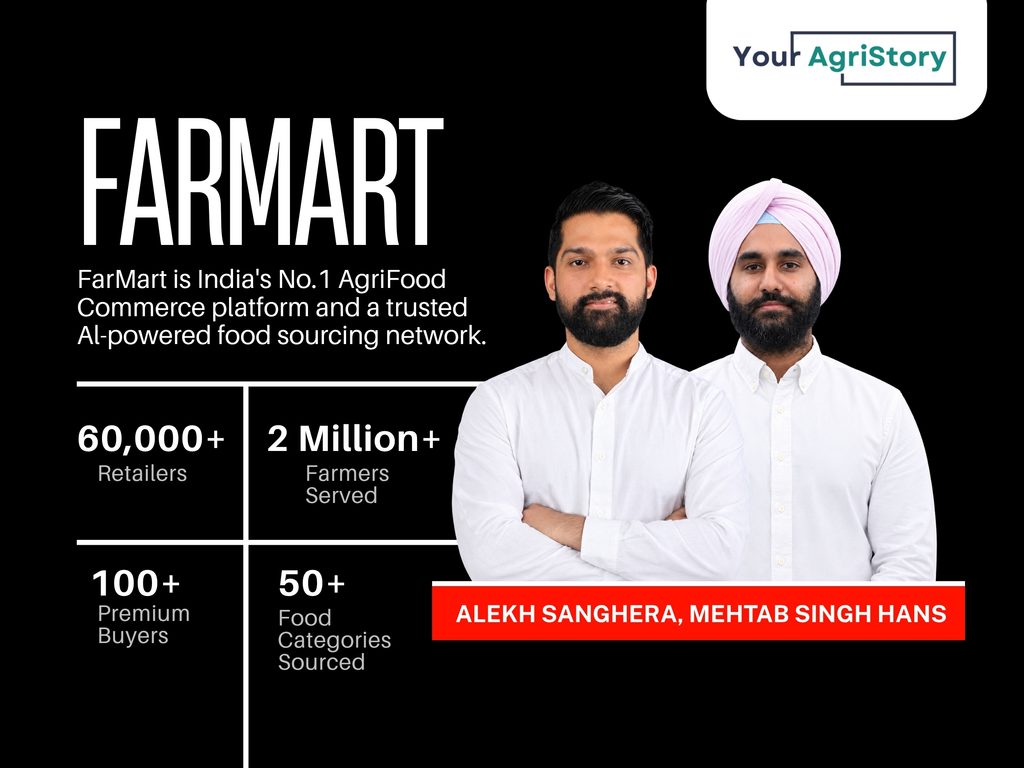
Co-founded by Alekh Sanghera (CEO) and Mehtab Singh Hans (COO), FarMart is taking on the messy world of rural agri-commerce. Indian grain trading has always been tied up in layers of brokers, slow paperwork, and razor-thin margins. FarMart fixes this by dropping specialized AI agents into every step of the transaction.Since many people who work in areas and sell things don’t like using phone keyboards FarMart uses voice assistants that speak local Hindi languages. These voice assistants make thousands of calls in a few minutes. They talk to people who grow crops to check how much is available write down the prices people are asking make sure people want to sell and get orders quickly over the phone.On the side the system uses computer programs to handle the forms and documents. The system looks at papers like the ones that show how much something weighs the bills for things and other papers. It checks 17 parts and compares them with government records, like Vahan to stop fake things from happening.This drops KYC verification from an hour down to 5 minutes, and cuts e-way bill generation to 5 seconds. By matching buyers and sellers based on actual trading history across 20+ commodities, FarMart speeds up payouts significantly. More than half of all supplier payments clear within 2.5 hours, giving local traders the cash flow they need to pay smallholder farmers on the very same day.
The Road Ahead:
These five companies show that AI, in agriculture is not just a fancy word or something studied in schools—it is really helping to get more crops reduce waste of water and other resources and give money to farmers more quickly.As these tools move to states and different kinds of crops using satellite information, local voice AI, smart robots and better supply chains will keep changing how Indian farming works for many years to come.