
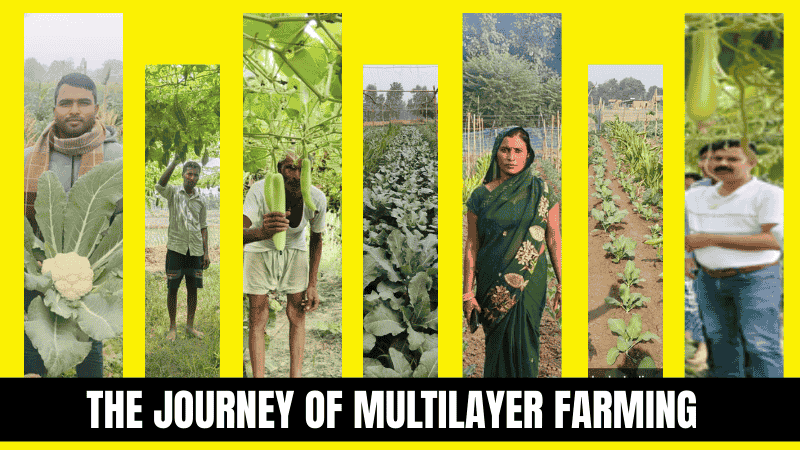

Farming revolutions are often imagined as loud affairs. New machines roll in, costs go up, and only a few farmers manage to keep pace. What happened in Muradnagar was the opposite.
On just 10 acres of land in Ghaziabad’s Muradnagar block, a quiet experiment began in 2021. There were no glossy promises or high-tech interventions. Instead, there was a simple question: could small and marginal farmers earn more from the same land by farming smarter, not harder?
With support from NABARD, the Agriliv Research Foundation introduced the Multilayer Farming model as a pilot. The idea was straightforward but ambitious. Stack crops vertically, use sunlight, soil and water more efficiently, and turn a single plot into multiple sources of income. What followed over the next few seasons was more than a technical shift. It was a change in how farmers looked at their land, their risks, and their future.
That 10-acre pilot did not just test a farming method. It quietly began to reshape Muradnagar’s farming landscape.
In the Muradnagar block of Ghaziabad, a quiet but powerful transformation began taking shape in 2021. This change wasn’t driven by big machines or expensive technology; it started with an idea. The Agriliv Research Foundation (ARF), supported by NABARD, introduced the Multilayer Farming (MLF) model on a small 10-acre pilot. Their vision was simple yet bold: prove that even small and marginal farmers can earn more, grow smarter, and build sustainable livelihoods.
What followed over the next four years is nothing short of inspiring. A model that started with 12 farmers gradually grew into a community-driven movement, influencing entire villages and setting a new example for sustainable agriculture in Uttar Pradesh.
How It Started: The First 10 Acres (2021–22)
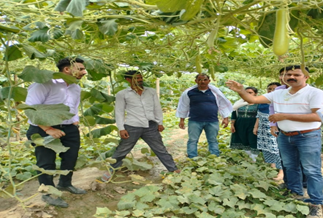
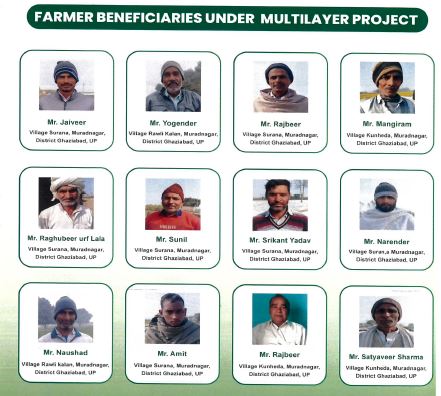
At the heart of the pilot were 12 farmers who chose possibility over convention. Instead of growing a single crop on their land, they adopted the multilayer method—root crops below the soil, leafy vegetables in the middle, creepers and fruiting vegetables on higher supports. This layering made sure that sunlight, soil nutrients, and water were used efficiently at every level.
The farmers didn’t have to wait long to see the results. Within the first season, they noticed:
- Higher yields from the same land.
- 40–50% less water use, which was a huge relief.
- Better pest management naturally.
- Frequent income from crops that grew at different times.
For farmers who were used to waiting months for earnings from a single crop, this system felt like a breath of fresh air. They finally saw a farming method that worked with nature instead of against it.
The success quickly caught the attention of nearby villages like Rawli Kalan, Kunehda, and Surana. Farmers from these villages began visiting the pilot fields, discussing the method, touching the crops, and understanding how the model actually worked.
A Movement Takes Shape: Farmer-to-Farmer Growth (2023–2025)
By 2023, the story took a decisive turn. The pilot farmers weren’t just participants anymore they had become examples. Other farmers trusted them, learned from them, and followed their lead. ARF and NABARD supported this wave by organizing training camps, field demonstrations, and exposure visits.
And slowly, the multilayer model started spreading like a ripple.
Adoption Growth Summary –
2021: 12 Farmers
2023: 75 farmers
2024: 150 farmers across three villages
2025: More than 300 farmers across the Muradnagar block
The numbers told a powerful story: a 525% rise in two years confirmed that the model worked on the ground scalable, practical, and community-friendly while Surana village stood out as the frontrunner, soon becoming the district’s model cluster for Multilayer Farming.
Farmers say the real motivation came from seeing the results in their neighbors’ fields. It wasn’t a lecture, a poster, or a training that convinced them it was the success of people just like them.
Why Farmers Loved the Multilayer Model:
The biggest reason was higher profit. Compared to traditional monocropping, Multilayer Farming gave farmers 3–5 times higher income per acre. But the money wasn’t the only benefit.
Over time, farmers noticed:
- Better soil fertility due to organic mulching
- Reduced dependence on chemical fertilizers
- Smart use of limited water
- Better resilience to unpredictable rainfall
- Continuous income throughout the year
Earlier, small farmers struggled because they relied on a single crop season. A bad season often means financial stress. MLF broke that cycle by giving them multiple crops at different intervals.
Women and youth also took active roles managing nursery preparation, harvesting short-duration crops, and learning integrated farming methods. This turned the model into a family-driven, community-led system rather than an individual experiment.
Impact by 2025: A District-Level Success Story
By 2025, Multilayer Farming had captured widespread attention in the region, with more than 300 farmers adopting the model, leading to a visible surge in vegetable production and a meaningful improvement in household incomes.
Farmers who once struggled with low yields and rising input costs started earning stable incomes. Many of them shared that for the first time in years, they felt confident about their future in agriculture. The model didn’t just increase income it increased hope.
Local markets benefited too. With diverse crops coming in throughout the year, vegetable availability improved and transportation needs reduced, giving both farmers and consumers an advantage.
The environmental benefits were equally strong. Healthier soil, lower chemical usage, better water management, and stronger climate resilience made the model a long-term solution rather than a temporary fix.
A New Chapter, Not the Final One
The journey from a 10-acre pilot to a block-level movement proves how powerful community-driven innovation can be. Multilayer Farming taught Muradnagar’s farmers that small landholding is not a weakness, it’s an opportunity to farm smarter.
Inspired by the success, ARF has now expanded the model to Maharajganj district, hoping to bring the same growth to more farmers across Uttar Pradesh.
The story of Muradnagar is not just about farming. It’s about belief, collaboration, and the courage of a few people who tried something new and ended up inspiring hundreds.