
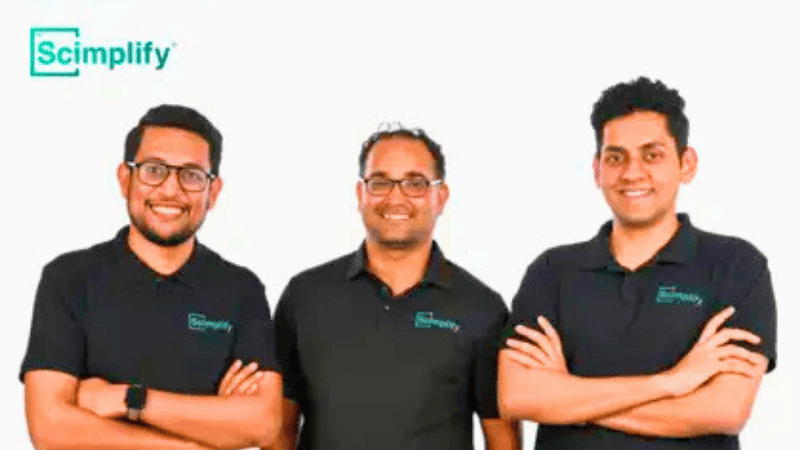

India has factories. India has talent. What it didn’t have was a bridge. That’s the one line from co-founder Salil Srivastava that explains the whole company in under ten words.
In 2023, Srivastava — who had led the chemicals vertical at Zetwerk before that — and Sachin Santhosh, an IIT-Madras alumnus who came out of Bizongo and OfBusiness, started Scimplify in Bengaluru. Not because the specialty chemicals market was hot. Because they’d both seen the same problem from the inside: hundreds of Indian chemical manufacturers running at partial capacity, decent infrastructure, real scientific capability, but no demand coming their way. And on the other side, global buyers — pharmaceutical companies, agrochemical formulators, personal care brands — spending months on broker calls trying to find the right Indian supplier, with zero guarantee on compliance or quality.
The mismatch was enormous. Nobody was fixing it systematically. So they built something to fix it.
Fast forward three years — 250+ manufacturing partners, 3,000+ products, 1,000+ clients across 20+ countries… and ₹1000 crore revenue. Pretty crazy growth.. That’s the distance covered. It doesn’t happen often and it doesn’t get talked about enough in the context of how fast this was built.
The Problem They Were Actually Solving:
This is the part that gets glossed over in milestone coverage and it really shouldn’t.
The global specialty chemicals supply chain had a structural problem — too much concentration in one place. China supplied a huge share of the world’s specialty chemical intermediates, and that worked fine until it didn’t. COVID disruptions hit. Then geopolitical tensions. Then tariff pressures. “China for everything” was a single point of failure that nobody had seriously stress-tested until it started breaking down.
At the same time, Indian manufacturers — genuinely capable ones — had no reliable way to connect with global demand. Discovery was broken. Compliance verification was relationship-dependent. Buyers couldn’t tell a quality supplier from a bad one without months of due diligence. The whole system ran on trust built slowly through personal contacts, not on any kind of transparent infrastructure. Scimplify’s answer was a tech platform called ATOMS — a system that connects verified Indian manufacturers to global chemical demand with transparency, compliance tracking, and end-to-end support from custom synthesis to commercial delivery. Not a directory. Not a broker. A full-stack platform. That distinction matters because it changes what buyers can actually rely on.
“For decades, specialty chemical manufacturers have invested millions in facilities that can only produce a handful of compounds, often running at partial capacity while lacking R&D capabilities. This creates a paradox — excess capacity alongside supply shortages. We’ve flipped this model.” — Sachin Santhosh, Co-Founder
₹1000 Crore — But Look at What’s Behind It:
The revenue number needs to sit with you for a moment before moving on.
This is not a single-product company that rode one commodity cycle well. Scimplify built across flame retardants, pharmaceuticals, food ingredients, flavors and fragrances, and industrial chemicals simultaneously. And now it’s scaling into oleo chemicals, photo chemicals, rare earth minerals, and battery chemicals. No single vertical is carrying the whole thing. That’s deliberately built-in resilience — not accidental diversification.
The breadth funded the depth. And the depth is where the next chapter sits.
The Agrochemical Push — This Is the Bigger Story
The ₹1000 crore is from the whole business. What comes next is more focused — and honestly more ambitious.
Scimplify is building a fully integrated agrochemical platform. Not just sourcing intermediates. Not just formulating. The full stack — intermediates, technical active ingredients, formulations, branded crop-protection products, crop nutrition, biological solutions. Lab to field. The company already ranks among top players in Potassium Humate and Emamectin Benzoate, and is a leading exporter of Profenofos. These aren’t niche molecules. These are high-volume, widely-used products across Indian and global agriculture. The commercial scale is already there, not just projected.
Why does this integration matter? Because every step in the value chain that Scimplify controls is a step where quality doesn’t slip and margin doesn’t leak to a middleman. A company that owns the intermediate, the formulation, and the brand can offer something a pure-play distributor simply cannot — consistency, faster market response, and better pricing to the farmer at the end of it. That’s the logic behind the model.
Vision 2026 is to be among India’s Top 30 agrochemical companies — with the agrochemical vertical alone targeting ₹1000+ crore. Separate from the overall business. So they’re essentially targeting a doubling of the current total company, inside one focused segment. Whether that lands depends entirely on execution. But the foundation being built under it is real.
To drive it, Sudheer Kumar was brought in as CEO – Agrochemicals. Fifteen years in the agrochemical value chain — Sumitomo Chemical India, UPL, ZETWERK. He’s not a hire for optics. He’s someone who’s done the hard distribution and commercial work that this kind of vertical actually requires on the ground.
$54 Million and the China+1 Timing:
Scimplify has raised $54.2 million across three rounds. Series A was $9.5 million, led by Omnivore and Bertelsmann India Investments in August 2024. Then Series B — $40 million, co-led by Accel and Bertelsmann in March 2025, at around $150 million valuation.
The timing of the Series B… that’s something to actually pay attention to.
Accel and Bertelsmann put $40 million into a three-year-old Indian specialty chemicals platform at exactly the moment global supply chains were actively trying to move away from China. US manufacturers were looking for compliant Indian alternatives and couldn’t find a reliable one. European buyers were stress-testing their supplier bases. The ATOMS platform was the infrastructure those buyers needed and couldn’t find anywhere else. The investors saw that shift happening and bet on the platform positioned at the centre of it.
That’s not just capital validation — it’s a structural bet on India’s role in global chemical supply chains. Those are different things.
Why This Model Is Hard to Copy:
This bit tends to get skipped over and it really shouldn’t.
A distributor can connect buyers to manufacturers. Many already do. What they can’t do is take a product from custom synthesis in a lab, through pilot scale, into commercial manufacturing, with full chemistry expertise at every step, and then deliver it with compliance documentation for US or EU regulatory standards — all under one roof. Scimplify built that through a combination of 40+ in-house scientists, proprietary R&D infrastructure in Hyderabad’s Genome Valley, and a manufacturing partner network that’s been vetted and enabled, not just listed.
Getting all of that working together consistently takes time to build and is genuinely hard to replicate quickly. That’s the moat — not the technology alone, but the scientific capability sitting behind it.
What’s Actually Happening Here:
₹1000 crore got it into the headlines. But a three-year-old platform — built to solve a real structural problem in global chemical supply chains, scaling across nine verticals while building a focused agrochemical business from intermediates all the way to branded farmer products — that’s what’s actually happening here.
The number just made it easier to see.