

When a cooperative built on farmer trust crosses ₹1 lakh crore in turnover, it stops being just a business milestone… it starts feeling like actual proof. Like okay — this model works. Not just in theory, not just at a small regional level, but at proper scale, in global markets, and still somehow connected to the village. And that combination is actually quite rare to hold together.
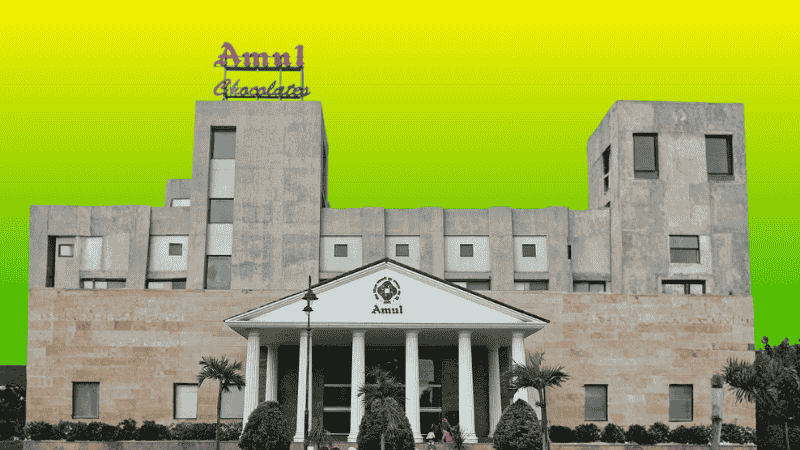
Gujarat Cooperative Milk Marketing Federation, the world’s largest farmer-owned dairy cooperative, reported that the Amul brand crossed ₹1 lakh crore for FY 2025–26. That’s an 11% rise from ₹90,000 crore the year before. And on its own that’s significant… but what makes it more interesting is this is not a typical corporate story. It’s a cooperative doing this.
The Numbers Behind the Brand
GCMMF’s own sales turnover grew 11.4% to ₹73,450 crore, up from ₹65,911 crore the previous year — and it still holds its position as India’s largest FMCG organisation, which is actually saying a lot when you think about what that category includes.
Now the ₹1 lakh crore figure — it’s not just one clean combined number, and that part matters. It includes the turnover of 18 member district cooperatives, each counted separately. So the revenue doesn’t just sit at the top of the organisation… it flows back into the cooperative system itself. That’s by design.
The federation collects around 3.1 crore litres of milk every single day and sells over 2,400 crore product packs annually. Butter, ghee, cheese, paneer, ice cream, chocolates, fresh milk… across more than 50 countries now. And the International Cooperative Alliance has ranked Amul the world’s No. 1 cooperative — which honestly should be a much bigger headline than it usually gets.
This milestone belongs to the trust of millions of consumers and the tireless effort of 36 lakh dairy farmers. — Ashok Chaudhary,Chairman,GCMMF
GCMMF chairman Ashok Chaudhary credited the achievement to consumer trust and farmer effort, while Vice Chairman Gordhan Dhameliya called it a validation of the cooperative model at scale. And both of those framings are accurate — not just PR language.
The structure of GCMMF is designed intentionally. Member district cooperatives retain their own turnovers, which then come together in the overall Amul figure. But this is not just accounting… It reflects the core idea behind the whole system. The value created by the brand should go back to the producers. That’s the point.
Unlike typical corporate models where focus eventually shifts to external shareholders, here farmers stay central to the value chain. And somehow, this model has managed to hold that structure even at this size — which is not easy to do. Most organisations lose that thread somewhere along the way.
Going Global — Fresh Milk in Europe and the United States
Amul is now expanding beyond India in a more direct way. Fresh milk in Europe and the United States… which puts a farmer-owned cooperative in direct competition with global dairy companies in their own markets. That’s not a small shift at all.
Managing Director Dr. Jayen Mehta stated that the goal is not just expansion — it’s also to show what a farmer-owned institution can actually achieve globally, while still making sure benefits reach producers back home. And honestly, that’s the harder part to maintain as you scale internationally.
With presence in more than 50 countries and over 2,400 crore packs sold annually, Amul is already operating at global scale. But without actually changing its core model while doing all of this. And that balance… is quite rare.
The Second White Revolution — A New National Federation
In July 2025, Union Minister Amit Shah launched the Sardar Patel Cooperative Dairy Federation Limited under the Multi-State Cooperative Societies framework — aimed at expanding and integrating dairy cooperatives across India. This is being called the beginning of the Second White Revolution.
The first White Revolution, led by Dr. Verghese Kurien, made India the world’s largest milk producer. That was a massive, structural shift. The second phase is now trying to bring more regions into the cooperative network — especially the ones still sitting outside it. Whether it reaches the same level of impact is something we’ll see… but the intent is clearly there.
What ₹1 Lakh Crore Actually Represents
The ₹1 lakh crore number will show up everywhere — reports, headlines, policy discussions.
But its real meaning is simpler than all of that.
It’s 36 lakh farmers. It’s 3.1 crore litres of milk collected every single day. And a system that has been running for more than seven decades without completely drifting from its original principle — that producers should benefit the most. At a time when agriculture is mostly discussed through reform debates and income gaps, the Amul model stands a bit differently. It’s not a government scheme, and it’s not a venture-backed company chasing growth.
It’s a farmer-led system built on trust.
So yeah — in the end, this milestone doesn’t really belong to the organisation alone. It belongs to every farmer who shows up at a collection centre every morning, pours milk, and just… trusts that the system is working in their favour.